Augusta Area Update
H1N1 “Swine Flu” pandemic
May 7 2010
Flu activity in Augusta and in the state appears to have abated over the past 6 weeks. During the period from mid-January to mid-April, there was a slight increase in hospitalizations and deaths reported to the Georgia State Health Department compared to the December-January period. That increase was also noted in Augusta, where a number of hospitals reported additional patients in their intensive care units and hospital inpatient units with suspected or confirmed H1N1. There was also a persistence of patients in Augusta area clinics and emergency departments presenting with flu-like illness. That persistent circulation of flu appears to have abated both in Augusta and in the state of Georgia.
During the week ending May 7, Augusta area physicians and hospitals are reporting little flu activity. One area hospital admitted a previously healthy adult with severe, rapidly progressive pnuemonia five days after she and her husband developed a flu-like illness. The monthly volume in the local Children’s Hospital emergency department in April was down compared to the marked increases seen from August to November 2009, and is more in line with the volume expected for this month based on past years. Local office-based pediatricians are not reporting unusual levels of respiratory illness in children this week.
March 30, 2010
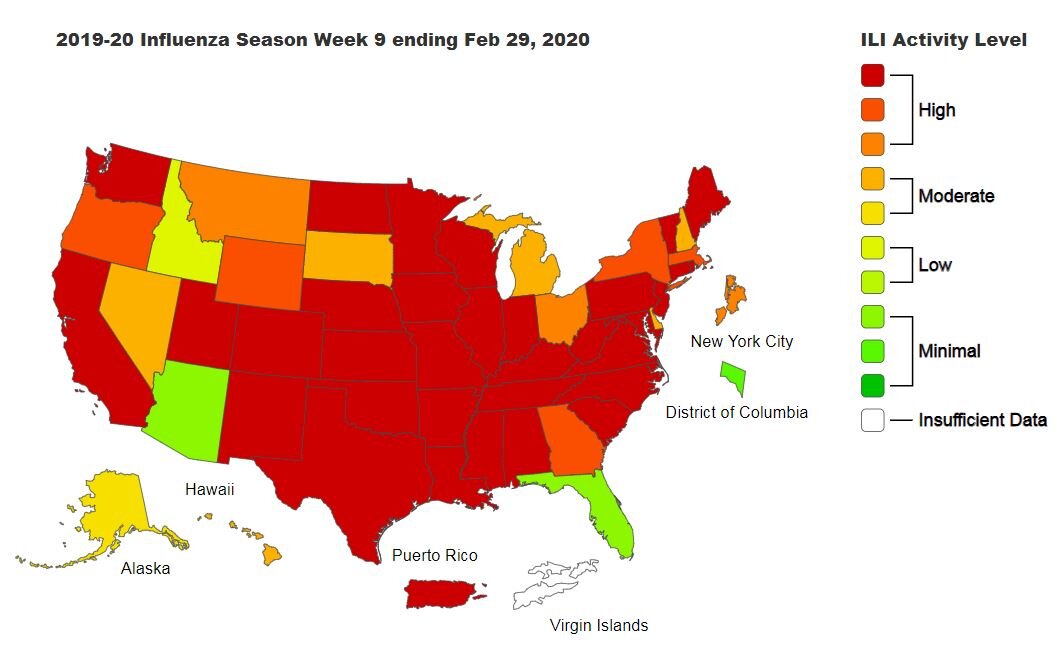
Georgia appears to be at the epicenter of flu activity in the US this week. The state health department issued a release last week stating that hospitalizations are up, and scattered reports of deaths due to 2009 H1N1 continue to be received from around the state. Click here to read the transcript from a CDC press conference held today that focuses on the resurgence of flu in Georgia and the southeast.
Two Augusta area hospitals reported to G-LINE this week about flu activity in their facilities. Both currently have inpatients with proven influenza. 2009 H1N1 has been confirmed in some, with results pending in several others. Although the numbers are small, this does represent more activity than was reported in Augusta 6 weeks ago. At least two Augusta area children were ill enough within the past week to require treatment for influenza in an intensive care unit.
Augustans should not be overly alarmed by this information. The number of infections is much smaller than it was in September, when the second wave of the pandemic peaked in the Central Savanna River Area. Augusta area emergency departments are not reporting unusually high numbers of people with flu-like illness this week.
It is not clear if this is the beginning of a “third wave” of the pandemic. At this point, the numbers do not justify labeling this resurgence as a true third wave.
March 22, 2010
Influenza is still present in the Region G area, but it appears to be circulating at low levels. Two Augusta hospitals reported admissions of patients with flu in the past two weeks, including one patient who was admitted to an intensive care unit (ICU) with confirmed H1N1. One of these hospitals further reported that they admitted 5 patients to their intensive care unit for influenza-like illness in February and nine so far in March.
Local emergency departments and clinics are not reporting unusually high patient volumes. Area hospitals are not reporting unusually high levels of employee absenteeism. It is important to note that Georgia, Alabama, and Mississippi are the only three states in the continental US still reporting regional flu activity, while seven nearby states are reporting local activity. This is the only region of the country that still has significant circulation of flu.
The “second wave” of H1N1 began in August 2009 in Georgia, spread quickly through the South East region, then spread nationally. H1N1 activity peaked in October 2009. It is not yet clear if we will see a third wave of flu from this pandemic. The fact that we have not had an increase in H1N1 during the winter months, the typical period for circulation of influenza, suggests that that the end of this pandemic may be near, at least until our next flu season begins in December.
G-LINE will continue to monitor and report on the situation.
February 4, 2010
Flu activity remains low, but it is not absent. Several primary care physicians in Columbia County reported multiple positive results on flu rapid test in pediatric patients last week. It is important to note that while flu is dramatically down over most of the country, Georgia still remains at Regional activity on the CDC map and is in the center of a South East Region that appears to be the primary focus of flu in the nation.
When H1N1 began to suddenly rise in August in Augusta, all area hospitals instituted policies restricting visitation to inpatient units by children under the age of 18. The reason for this was that children have been the primary targets for this influenza subtype. By restricting their access to the inside of hospitals, officials felt they were better able to protect vulnerable patients and staff. Most regional hospitals have lifted these restrictions now that the second wave of H1N1 appears to be past us. However, visitors with flu-like illness should still voluntarily exclude themselves.
It is not clear if we can expect a third wave of H1N1 this winter. We are well past the second wave, which peaked in October. So far there are no reports of significant numbers of patients reported with typical seasonal flu strains. However, there is still flu activity in the South East Region, which could escalate into a third wave of H1N1. This would prompt the resumption of restrictions.
January 14, 2010
Flu activity in Augusta and in the state of Georgia is now negligible. Volumes in area emergency departments and clinics are down substantially from September and October when H1N1 was circulating heavily in our community. Patients continue to present with influenza-like illness, or ILI, but most of these people are infected with other respiratory viruses and not with flu. The symptoms are quite similar, and just as in patients with flu, most of these patients can be cared for at home with supportive care alone. Viral respiratory infections are generally self limiting, meaning they last a predictible period of time and then resolve without any interventions from a doctor. Antibiotics are of no value in the treatment of any viral infection; they are useful only for infections caused by bacteria, such as Strep throat or urine infection.
H1N1 vaccine is plentiful in the Augusta area for those who would like to receive the vaccine. While H1N1 is largely gone from the Augusta area, it is still possible that we will see its return in a “third wave”, possibly during our usual flu months of January through March.
December 23, 2009
The fall wave of H1N1 appears to have passed Augusta. Patients with influenza-like illness (ILI: sudden onset of fever PLUS cough or sore throat) continue to present for care, but these symptoms do not appear to be due to H1N1; there have been no reports of patients positive for H1N1 in Augusta at three major area hospitals in the past 4 weeks. A significant portion of the patients in emergency departments and clinics with ILI also have conjunctivitis, or “pink eye”, suggesting Adenovirus as the cause. Like flu, adenovirus infections are largely self-limiting and do not respond to antibiotics. Treatment of these viral respiratory infections includes bed rest, lots of fluids, fever lowering medications for comfort, and time. Most patients have shown significant improvement in 5-7 days.
H1N1 vaccine is now plentiful in Augusta and available for anyone who wants it. The vaccine is no longer targeted only for high risk individuals.
Dec 4, 2009
The “second wave” of Swine Flu that appeared in the Augusta region in August is clearly on the decline. None of three major area hospitals reporting to G-LINE this week have confirmed any cases of H1N1 influenza in the past four weeks. The number of patients presenting to area hospitals and emergency departments with influenza-like illness is down substantially. Rates of influenza-like illness in Georgia and around the country have been on the decline for at least four weeks. In response, some hospitals in Augusta have suspended their policies restricting visits to inpatient units by children.
The state Health Department issued a statement today indicating that H1N1 vaccine supply and demand are coming into balance. As a result, H1N1 vaccine is no longer restricted to priority groups. Anyone who wants H1N1 vaccine should now be able to get it. See the update and original letter under “Information for Doctors”.
Nov 20, 2009
The thirteen counties in Region G (Augusta Ga and surrounding counties) continue to see large numbers of patients with ILI, although the numbers appear to be declining. All area hospitals continue to limit visitation by children. No area hospitals have implemented their ER surge or disaster plans for H1N1 at this time. All hospitals continue to monitor flu activity, paying particular attention to people who are sick enough to require admission to an intensive care unit. All hospitals are also monitoring ED visits and sending summary data to the appropriate local, state and federal agencies. So far school absenteeism has not been a major problem, and we anticipate that the coming Thanksgiving break may help to further supress the spread of the H1N1 virus.
Nov 11, 2009
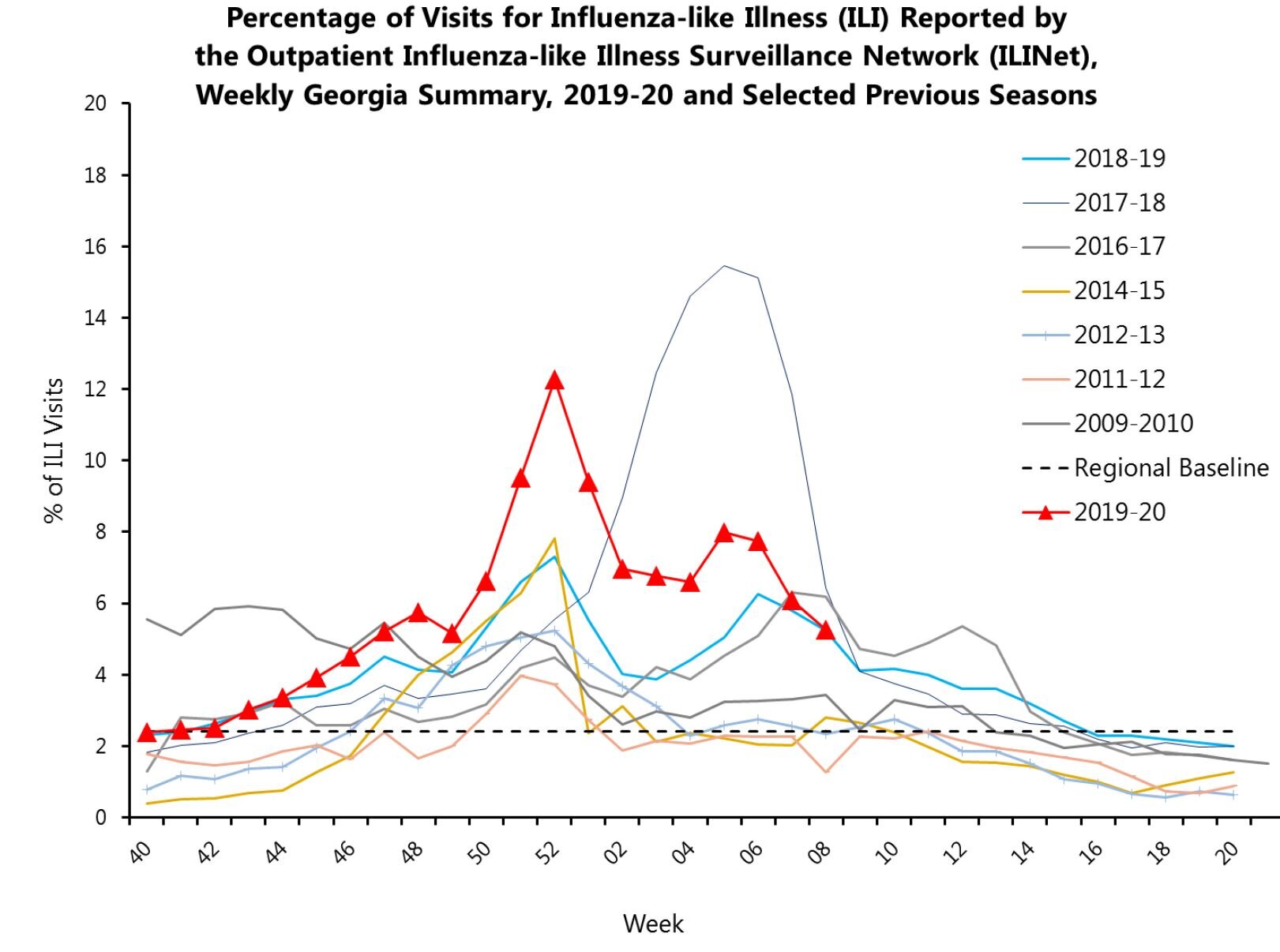
The steady decline in the rate of flu-like illness (ILI) in the state of Georgia appears to have leveled off, with some ILI activity still remaining in our state. Currently about 5-6% of all visits to clinics and emergency departments in Georgia are for ILI after peaking at close to 12% during the first week of September. In Augusta, clinics and emergency departments remain busy but the volume of patients is much lower than it was 6 weeks ago. Augusta area hospitals continued to confirm H1N1 in inpatients during the last two weeks of October, but the number appears to be declining. Tamiflu and Relenza, the two antiviral medications that are effective against H1N1 “Swine Flu”, are still available in the Augusta area, although the pediatric suspension of Tamiflu is reportedly hard to find.
Two deaths have been reported from the Augusta district since the “second wave” of H1N1 began in late August. There have been 30 deaths due to H1N1 in Georgia since Sept 1, including 2 children age 0-4 years, 5 children age 5-18 years, 1 young adult 19-24 years, 11 adults 25-49 years, 10 adults 50-64 years, and 1 adult over the age of 65.
Nov. 2, 2009
The state of Georgia and the Augusta region have shown a steady decline in the proportion of patients with flu-like illness since the middle of September. Area clinics and emergency deparments are still busy compared to the same period last year, but not nearly as much as they were just four weeks ago. Our state was the first in the US to see the resurgence of H1N1 in August, probably because our children go back to school earlier than the children in the rest of the country. The fact that Georgia largely escaped the H1N1 outbreak in May and June may also have played a role in our state leading the resurgence. There were 26 deaths due to H1N1 reported in Georgia from Sept 1 to Oct 29, including two from the Augusta District.
Oct. 1, 2009
The H1N1 pandemic flared in Augusta in mid-August as it did throughout the state, probably due to the start of the new school year. H1N1 has caused a significant amount of illness since then in Region G, which includes Augusta and 8 nearby Georgia counties. Private physician offices and local emergency departments are experiencing markedly increased patient volumes compared with the same period last year. As is true around the country, this pandemic has so far had a much greater effect on children and young adults than on older adults. In the Medical College of Georgia Emergency Department, pediatric volume for the month of September was 60% above that for September of 2008, while the volume of adult patients showed no change. Most of the patients with flu-like illnesss are able to be managed at home, usually without the need for antiviral medications such as Tamiflu. Only a small number of patients have required admission to the hospital due to flu. There has been only one death in Augusta confirmed to be due to H1N1.